






Something a beach umbrella provides?
Postado por Admin
A beach umbrella provides shade — but that single word barely scratches the surface of what a quality canopy does for your day at the shore. It blocks UV radiation, lowers the temperature beneath it by as much as 10–15°F (5–8°C) compared to full sun, shields you from light wind, creates a private visual anchor in a crowded beach, and gives children and fair-skinned adults a safe place to rest between swims. In short, a beach umbrella is a portable micro-environment that makes hours at the beach not just bearable but genuinely enjoyable.
UV Protection: The Core Thing a Beach Umbrella Provides
The single most important function of a beach umbrella is protection from ultraviolet radiation. The sun emits two types of UV rays that reach the earth's surface: UVA and UVB. UVB rays cause sunburn within minutes of exposure, while UVA rays penetrate deeper into the skin and contribute to premature aging and long-term cellular damage. A beach umbrella blocks both — but the degree of protection depends heavily on the fabric, the UPF rating, and the angle of the canopy relative to the sun.
According to a study published in JAMA Dermatology (2017), beach umbrellas with a UPF (Ultraviolet Protection Factor) of 50+ can block up to 77% of UV radiation. That same study found that people sitting under shade umbrellas still experienced sunburn because of UV scatter from surrounding sand and sky — which is why using sunscreen alongside a beach umbrella remains necessary. However, the umbrella significantly reduces the baseline UV load your skin absorbs over the course of an afternoon.
The American Academy of Dermatology recommends seeking shade between 10 a.m. and 2 p.m. when UV intensity peaks. A beach umbrella makes this practical: you don't have to leave the beach; you create your own shade wherever you set up.
UPF Ratings Explained
Not all canopy fabrics are equal. Many entry-level beach umbrellas use lightweight polyester that offers minimal UV blocking in its natural state. Higher-end umbrellas use tightly woven fabrics with UV-blocking chemical treatments baked into the fibers. The table below compares common UPF ratings and what they mean for protection under a beach umbrella:
| UPF Rating | UV Blocked | Protection Category | Suitable For |
|---|---|---|---|
| UPF 15–24 | Up to 93% | Good | Casual, low-sun periods |
| UPF 25–39 | Up to 96% | Very Good | Standard beach outings |
| UPF 40–50 | Up to 97.5% | Excellent | Extended beach days, families with kids |
| UPF 50+ | 98%+ | Maximum | Fair skin, infants, post-surgery recovery |
When selecting a beach umbrella for UV protection, prioritize canopies labeled UPF 50+ with a dense weave that resists UV scatter from the sides. A larger canopy diameter — 7 to 9 feet is the standard range — also helps by reducing low-angle UV penetration in the morning or late afternoon hours.
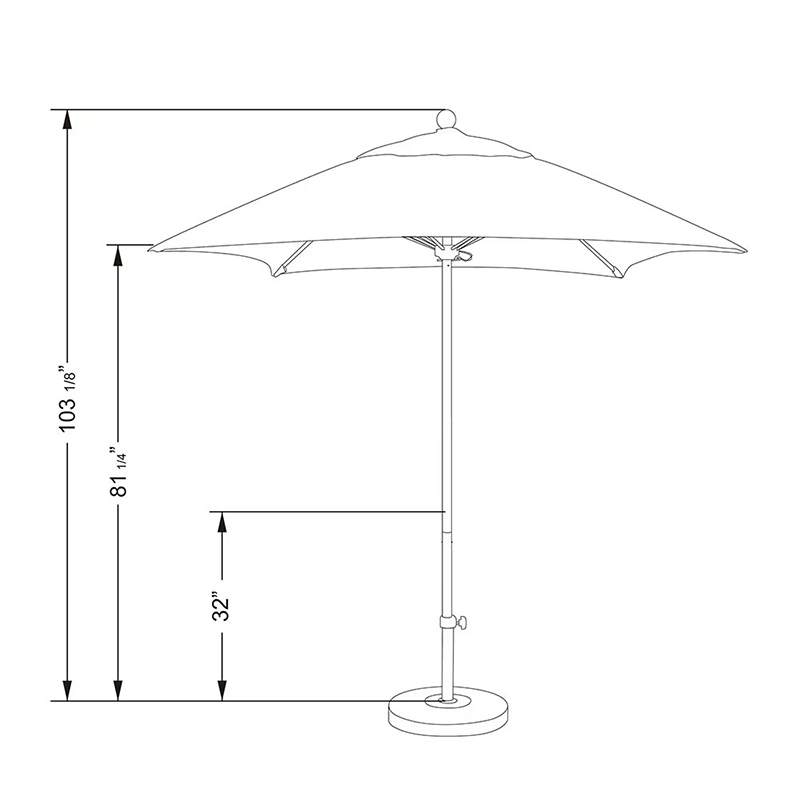
Heat Reduction: How Much Cooler Does a Beach Umbrella Make It?
One of the most immediately felt things a beach umbrella provides is a dramatic drop in perceived temperature. Sand absorbs solar radiation and re-radiates it as heat, which means the air at ground level on a sunny beach can feel significantly hotter than the official air temperature. A beach umbrella intercepts direct solar radiation before it reaches the sand and skin beneath it, cutting the heat load on both.
Temperature drop beneath a beach umbrella versus direct sun exposure on a typical summer day
Higher surface temperature of dark sand in full sun compared to sand under a shaded beach umbrella
UV radiation blocked by a UPF 50+ rated beach umbrella (source: JAMA Dermatology, 2017)
Researchers at a coastal environmental lab in Spain measured sand surface temperatures in direct sun at up to 65°C (149°F) on summer afternoons, while the same sand under a beach umbrella stayed below 38°C (100°F). For children who play barefoot on the sand, this temperature difference is not merely a comfort issue — it's a safety one. Bare feet on sun-baked sand can suffer burns within seconds.
Wind also plays a role in the cooling benefit. A beach umbrella with ventilation panels — a double-canopy design — allows airflow through the top of the umbrella, pulling hot air upward and drawing cooler air in from the sides. This chimney effect can enhance the cooling beneath the canopy by several additional degrees versus a sealed single-layer canopy design.
Wind and Sand Protection: Shelter Beyond Just Shade
Anyone who has tried to eat lunch at the beach on a breezy day knows the experience: sand in the food, sand in the eyes, napkins airborne. A well-angled beach umbrella provides meaningful wind deflection at the seating level. Positioned correctly — tilted into the wind at a 20–30 degree angle — a beach umbrella can cut the wind speed experienced beneath it by up to 40–60%, depending on canopy size and wind direction.
The key is anchoring. A beach umbrella's pole needs to be sunk at least 18 inches into the sand for adequate stability in moderate coastal winds. At popular beach destinations in the U.S., local regulations often require proper anchoring specifically because unsecured beach umbrellas become airborne in gusts, posing a hazard to other beachgoers. The Consumer Product Safety Commission (CPSC) has documented beach umbrella-related injuries exceeding 2,800 annually in the U.S., with the vast majority caused by improperly anchored umbrellas becoming projectiles in wind.
Spiral-point poles — where the lower section of the pole is designed like a corkscrew — provide significantly better anchoring than straight poles. When twisted into packed sand, they resist pull-out forces several times greater than a straight pole at the same depth. If you're buying a beach umbrella for a windy coastal location, look for this feature specifically.
What to Look for in a Wind-Resistant Beach Umbrella
- Double-canopy vented design to reduce uplift forces in gusts
- Fiberglass or carbon fiber ribs instead of aluminum — they flex rather than break in strong wind
- Spiral or screw-point pole for deeper, more secure anchoring
- Adjustable tilt mechanism so the canopy angle can be tuned to the wind direction
- Sand anchor bag as a base weight for extra stability on packed sand
Comfort and Rest: The Underrated Role of a Beach Umbrella
Beyond physical protection, a beach umbrella provides a psychological anchor. In a wide, undifferentiated landscape like a beach, having a visible, distinctive spot — your umbrella, your towel, your cooler — gives a sense of territory and comfort that open beach without a base simply doesn't offer. This is particularly relevant for families: children can spot their family's beach umbrella from the water, making it a safety landmark as much as a shading device.
Napping on the beach under a quality umbrella is a fundamentally different experience from napping in full sun. Core body temperature stays lower, the risk of dehydration during rest is reduced, and the quality of sleep is measurably better. A study from the University of Athens found that people who rested in shaded outdoor environments during midday heat showed lower heart rates and cortisol levels compared to those resting in full sun, even when both groups were lying down.
For elderly beachgoers and very young children, this rest quality is not a luxury — it's a health consideration. Heat exhaustion can set in rapidly in populations with reduced thermoregulation capacity. A beach umbrella's shade zone creates a safer microclimate that extends how long these groups can comfortably spend at the beach.
Core benefits at a glance
- Visual landmark for families in crowded beaches
- Lower core body temperature during midday rest
- Reduced dehydration risk in shaded zone
- Privacy in open, crowded environments
- Safe space for infants who cannot tolerate direct sun
Device and Gear Protection: Something People Overlook
A beach umbrella provides shade not just for people but for everything in your setup. Electronics — phones, tablets, e-readers — are among the most vulnerable items on a beach. Direct sun exposure raises device surface temperatures rapidly: a smartphone left in direct summer sun can reach internal temperatures of 95°C (203°F) within 30 minutes, well above the safe operating threshold of most consumer electronics (typically capped at 45°C / 113°F for internal temperature). Modern phones will throttle performance or shut down automatically to prevent permanent damage.
Under a beach umbrella, these same devices stay within a usable temperature range throughout the day. Coolers also perform better in shade: a standard soft cooler that keeps ice for 6 hours in direct sun may extend to 10–12 hours of ice retention in the shade beneath a beach umbrella, simply because the cooler's exterior is not absorbing additional radiant heat.
Skin care and sunscreen products degrade faster in direct heat and UV exposure. Sunscreen stored in a beach bag under full sun for several hours can experience formula breakdown that reduces its effective SPF. Keeping these products in the shaded zone under your beach umbrella maintains their integrity throughout the day.
What a Beach Umbrella Protects Beyond People
- Smartphones and tablets — prevented from overheating and shutting down
- Food and drinks — coolers retain ice significantly longer in shade
- Sunscreen and skincare products — formula integrity maintained
- Books, magazines, and reading materials — pages and bindings don't warp in heat
- Babies' skin and toys — plastic toys left in direct sun can reach temperatures that burn a child's hands
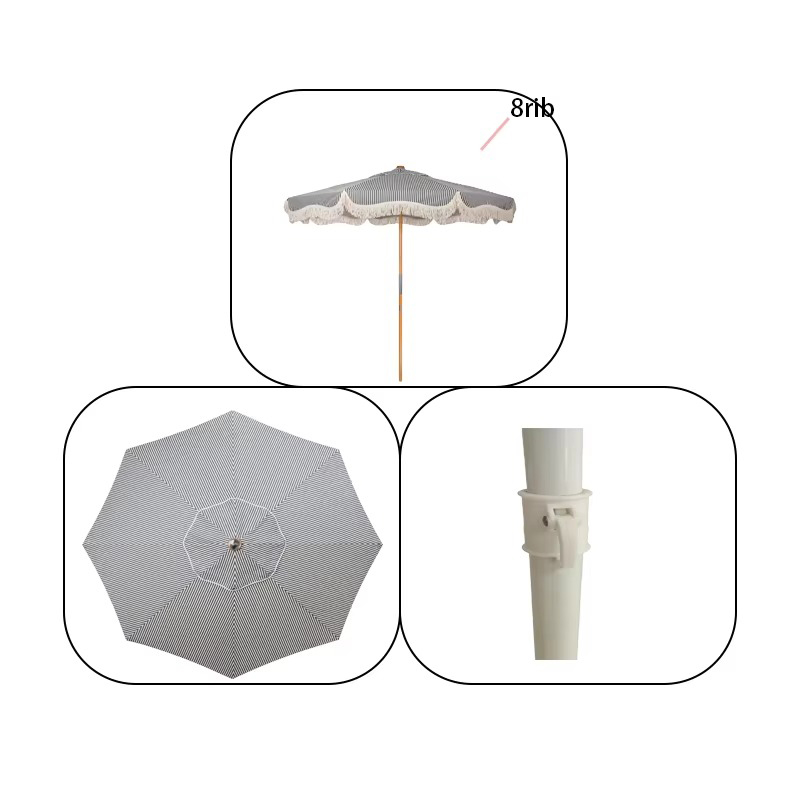
Types of Beach Umbrellas and What Each Provides
Not every beach umbrella provides the same things at the same level. The type you choose should match the primary benefit you need most from it. Here's how the main categories compare:
Standard Round Beach Umbrella (6–8 ft)
The classic format. Provides adequate shade for 1–2 people in a compact, lightweight package. Typically weighs 3–5 lbs, easy to carry from parking to beach. Best for casual beachgoers who want basic UV and shade coverage without the complexity of larger systems. Canopy coverage is roughly 28–50 square feet.
Large Beach Umbrella (9–11 ft)
Designed for families or groups. Provides coverage for 3–5 people simultaneously. Heavier at 6–10 lbs, usually requires a wheeled cart for transport. The larger canopy significantly reduces low-angle UV in the morning and late afternoon hours that smaller umbrellas miss. Coverage area of 63–95 square feet.
Vented Double-Canopy Beach Umbrella
The top tier for wind-resistance. The gap between the inner and outer canopy allows air to escape upward rather than pushing the umbrella over in gusts. Best suited for exposed coastal locations with consistent afternoon wind. Provides the same UV and shade benefits as standard models plus superior stability.
Beach Umbrella with Side Wall Panel
Some beach umbrellas include an attachable privacy or wind-break panel that hangs from one side. This provides significantly enhanced protection from low-angle afternoon sun, wind-blown sand, and some degree of privacy. Particularly useful for nursing mothers and families with very young children who need a more enclosed microenvironment.
Compact Pop-Up Beach Shade Tent
Technically not an umbrella, but often used as an alternative for maximum coverage. Provides four-wall shade and can accommodate a family. Unlike a traditional beach umbrella, a pop-up tent significantly reduces scatter UV from sky and sand. Requires more setup time and takes up more beach real estate, but provides the most comprehensive UV protection available in a portable format.
Sun Safety for Children: Why a Beach Umbrella Is Essential
Children's skin is thinner and more sensitive to UV radiation than adult skin. The American Cancer Society notes that just one blistering sunburn in childhood or adolescence more than doubles a person's chance of developing melanoma later in life. Given this, a beach umbrella is not optional beach equipment for families with children — it is a baseline necessity for responsible sun management.
The American Academy of Pediatrics advises against applying sunscreen to infants under 6 months of age, which means that for babies, a beach umbrella's shade is the primary protective tool available at the beach. Parents of infants should look for umbrellas with UPF 50+ canopies and side panels that block scatter UV from the sand, as a baby lying flat on a blanket can receive significant UV exposure through reflected radiation even under a standard umbrella.
For toddlers and young children who run in and out of the shade, the beach umbrella provides a recovery zone between bursts of activity. A child who returns to the shade every 20–30 minutes during peak sun hours dramatically reduces their total UV dose for the day compared to a child who stays in the sun for a continuous three-hour stretch, even if both are wearing sunscreen. The shade provides cumulative protection that compounds over the course of a beach day.
How to Maximize What a Beach Umbrella Provides
Owning a beach umbrella is not the same as using it effectively. The way you set it up determines how much protection it actually delivers. These practical steps make a measurable difference:
- Angle toward the sun, not straight up. A beach umbrella set at 90 degrees to the ground provides maximum overhead shade but leaves the low-angle morning and afternoon sun completely unblocked at face and torso level. Tilt the canopy toward the sun — the shadow should fall directly over your seating area, not behind you.
- Drive the pole at least 18 inches deep. Use the twist-and-push method, rotating the pole with each push to use friction rather than brute force. In loose dry sand, go deeper — 24 inches if possible. Always use a sand anchor bag as a secondary anchor if your umbrella includes one.
- Reposition every 1–2 hours. The sun moves. A beach umbrella positioned perfectly at 11 a.m. may be providing only 50% of its effective coverage by 1 p.m. as the sun's angle changes. Check the shadow footprint regularly and adjust the tilt accordingly.
- Don't rely on the umbrella alone. Even under a UPF 50+ beach umbrella, UV scatter from sand and sky accounts for a meaningful dose of UV radiation. Apply SPF 30+ sunscreen to all exposed skin, including areas in the shade zone.
- Extend coverage with additional gear. A beach umbrella works best as the centerpiece of a shade system. Combine it with a UPF sun hat, UV-protective clothing, and a beach tent for children if you're planning an all-day outing during peak summer months.
- Check the canopy's condition before the season. UV exposure degrades fabric over time. A beach umbrella that provided UPF 50+ coverage when new may test at a significantly lower rating after two or three seasons of heavy use. If the canopy has faded visibly, it's time to replace it.
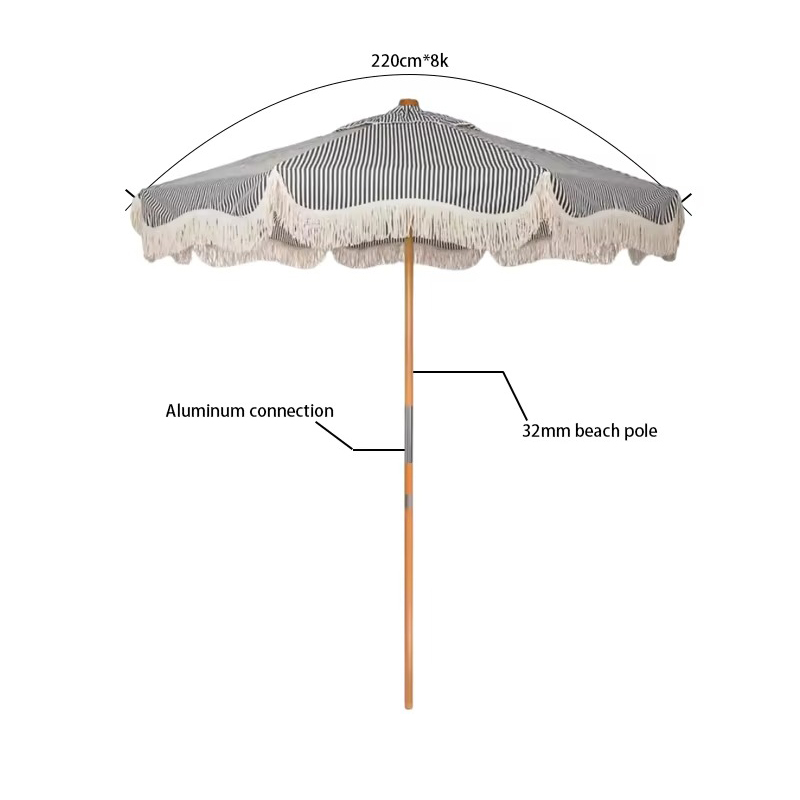
Materials and Build Quality: What Determines the Life of a Beach Umbrella
A beach umbrella's durability is primarily determined by three components: the canopy fabric, the rib material, and the pole construction. Understanding what each contributes helps you select an umbrella that will actually hold up over multiple seasons rather than ending up bent or torn after its third outing.
Canopy Fabrics
Polyester is the most common beach umbrella fabric. It's lightweight, affordable, and holds color well. However, standard polyester offers minimal UV blocking without a UV-blocking chemical treatment. Olefin (polypropylene) fabric is denser and naturally more UV-resistant, though it tends to be heavier. Solution-dyed acrylic — the material used in premium outdoor furniture and marine applications — offers the best combination of UV resistance, color retention, and durability. It resists fading, mildew, and salt air degradation significantly better than polyester alternatives, with an outdoor lifespan of 5–7 years compared to 1–3 years for standard polyester.
Rib Materials
Aluminum ribs are lightweight and corrosion-resistant, making them a good default choice for beach use where salt air is a constant. However, aluminum ribs snap under stress rather than bending, which means a single gust can result in a broken rib. Fiberglass ribs flex significantly before failing, which makes them more suitable for frequently windy beach environments. Steel ribs are heavy but nearly indestructible; they're typically found only in the heaviest commercial-grade beach umbrella models designed for resort or lifeguard station use.
Pole Construction
Most consumer beach umbrellas use an aluminum pole, which offers an excellent weight-to-strength ratio. Look for poles with a wall thickness of at least 1.5mm for adequate rigidity. Fiberglass poles are also available and offer better flex without the risk of aluminum fatigue at the point of repeated bending. The tilt mechanism — the joint that allows you to angle the canopy — is frequently the first point of failure on affordable beach umbrellas. A push-button tilt with a spring-loaded locking pin will outlast a basic friction-locking collar significantly. Check the tilt mechanism before purchase if possible.
Beach Umbrella vs. Beach Tent: Which Provides Better Protection?
The comparison between a beach umbrella and a beach tent comes up regularly for families planning extended beach outings. Both provide shade; each provides something the other doesn't. The choice comes down to what you prioritize and how you use the beach.
| Factor | Beach Umbrella | Beach Tent / Pop-Up Shade |
|---|---|---|
| Overhead UV Protection | Good to Excellent (UPF 50+) | Excellent |
| Scatter UV from Sand/Sky | Partial block | Full block on open sides |
| Portability | Excellent — single pole, bag or sleeve | Good — bulkier, heavier pack |
| Setup Time | Under 2 minutes | 2–10 minutes depending on design |
| Airflow/Ventilation | Excellent — fully open sides | Varies — open tent or enclosed |
| Wind Stability | Good with proper anchoring | Better — lower center of gravity, stakes |
| Space Efficiency | Excellent — minimal footprint | Larger footprint on beach |
| Price Range | $20–$300 | $40–$400 |
The practical recommendation for most families: use a beach umbrella as the primary shade structure and supplement with a pop-up tent for infants or anyone who needs more enclosed, all-angle UV protection. The two work well together and cover each other's gaps efficiently.
Frequently Asked Questions About Beach Umbrellas
Does a beach umbrella actually prevent sunburn?
A beach umbrella significantly reduces your UV exposure and lowers the risk of sunburn, but it does not eliminate it entirely. Scattered UV from sand, sky, and water can still reach skin under the umbrella. The 2017 JAMA Dermatology study found that people relying on shade umbrellas alone still got sunburned during prolonged beach exposure. Combining a UPF 50+ beach umbrella with SPF 30+ sunscreen provides substantially better protection than either method alone.
What size beach umbrella provides the most shade?
Canopy diameter directly determines the shadow footprint. A 9-foot beach umbrella provides roughly 63 square feet of canopy coverage and can shade 3–4 adults comfortably on towels. An 11-foot canopy provides close to 95 square feet. For families, 9 feet is the practical minimum; for couples or solo use, a 7-foot canopy is adequate and easier to transport and set up.
How do I keep my beach umbrella from blowing away?
Anchor the pole at least 18–24 inches deep using a twist-and-push technique. Use a spiral-tip pole for better sand grip. Tilt the canopy into the wind rather than straight up — this reduces the wind's ability to catch the underside of the canopy. Attach a sand anchor bag to the pole base if your umbrella includes one, and use ground stakes if available. In sustained winds above 25 mph, close and take down the umbrella — no anchoring system is reliable at that wind speed with a standard consumer beach umbrella.
Can I use a beach umbrella at the pool?
Yes. A beach umbrella provides the same UV, shade, and heat-reduction benefits at a pool as at the beach. The pole anchoring will differ — most pools have umbrella bases that the pole slots into, or you can use a weighted sand anchor bag on hard surfaces. Solution-dyed acrylic canopy fabrics are particularly well-suited for pool environments because they resist the bleaching effects of chlorine splash and reflected light.
How long does a beach umbrella last?
A standard polyester-canopy beach umbrella in regular seasonal use typically lasts 2–4 seasons before the UV-blocking treatment degrades and the fabric fades noticeably. A solution-dyed acrylic canopy can last 5–10 seasons under similar conditions. The ribs and tilt mechanism are usually the structural failure points before the canopy itself wears out on quality models. Rinse the canopy with fresh water after each use, let it dry fully before storage, and store it in a UV-protective sleeve to extend its usable life.
Is a white or light-colored beach umbrella better than a dark one for UV protection?
Fabric color has less impact on UV protection than fabric weave density and UPF treatment. A densely woven dark-colored canopy with UPF 50+ treatment will outperform a loosely woven white canopy with no UV treatment. However, lighter colors reflect more visible light and feel subjectively cooler beneath, while dark colors absorb more heat. If UPF ratings are equal, a light-colored canopy provides a slightly cooler experience but not necessarily better UV protection.
Produtos recomendados
Entre em contato conosco agora
Copyright 2024 @ Shaoxing Jinqiao Umbrella Co., Ltd. Todos os direitos reservados.
